大秦帝国
Political preferences clash with warship building realities as Trump pushes costly Ford class carrier revamp: experts_我的网站

一 |
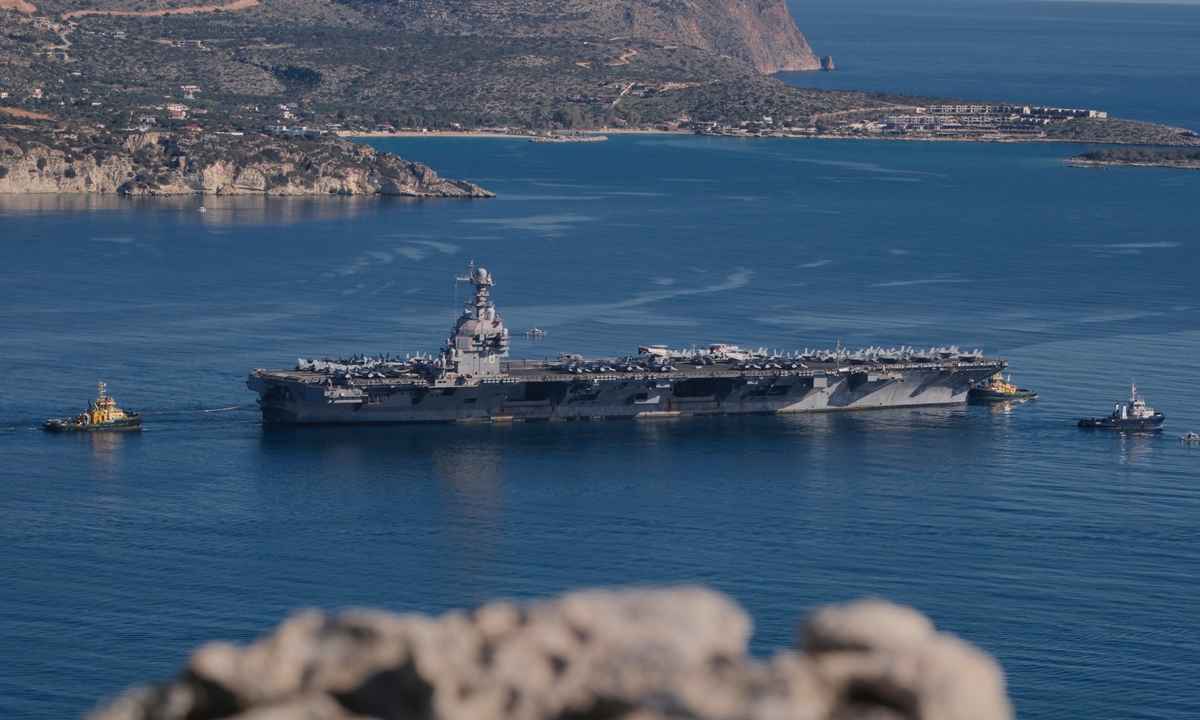
The USS Gerald R. Ford departs from Souda Naval Base near Chania on the island of Crete, Greece, on February 26, 2026. Photo: VCGUS President Donald Trump's reported push to reshape the US Navy's next-generation aircraft carriers - from moving the island to abandoning electromagnetic catapults in favor of steam-powered systems - could impose heavy engineering, financial and schedule costs, Chinese military affairs experts said, warning of a widening gap between political preferences and the realities of building some of the world's most complex warships.
The Washington Post reported on Saturday that the US Navy is considering a major redesign of its new Ford-class aircraft carriers to better match Trump's preferred aesthetic, with the president favoring ships that more closely resemble US carriers from the World War II era. One option under study would move the carrier's island farther forward, toward the middle of the ship.
US officials cited by the report warned that such a change could require billions of dollars in redesign costs and cause substantial delays.
The potential island redesign comes only days after Trump ordered another far-reaching change to the Ford-class program. On Thursday, he signed a national security memorandum directing the Pentagon and Navy to develop a plan within 60 days to replace the Electromagnetic Aircraft Launch System (EMALS) with steam catapults and the Ford-class carriers' Advanced Weapons Elevators with hydraulic systems, beginning with the future
USS Doris Miller, or CVN-81, USNI News reported.
Trump has repeatedly criticized EMALS as "too complex" and "not as effective as steam catapults," according to Reuters.
But the order would reverse a technology path the US Navy has pursued for more than a decade. When the Navy selected EMALS in 2009, it said the system would lower overall lifecycle costs, require less maintenance than steam catapults and place less physical stress on carrier-based aircraft, per Reuters.
As of March 2026, the
USS Gerald R. Ford had conducted 36,863 EMALS launches, according to Pentagon documents cited by Reuters.
General Atomics, the manufacturer of EMALS, has warned against changing course on the
Doris Miller, saying nearly 50 percent of production related to the system has already been completed and that a switch now would create significant cost, schedule and integration risks, according to Reuters.
Zhang Junshe, a Chinese military affairs expert, told the Global Times on Sunday that the Ford-class carrier's aft-positioned island is not merely an aesthetic choice, but is closely tied to flight-deck efficiency and landing safety. "Moving the island farther aft creates more space around the catapults for aircraft parking and handling, helping shorten launch preparation time, while also reducing airflow disturbance during aircraft recovery," he said.
Relocating the island forward would not be a simple cosmetic adjustment, but a major redesign affecting weight distribution, buoyancy, flight-deck layout and aerodynamics, with significant implications for both cost and schedule, Zhang noted.
Song Zhongping, another Chinese military affairs expert, told the Global Times that Trump's demand is one thing, but turning it into an actual warship design is another.
"The first four Ford-class carriers have either entered service or are already in different stages of construction, leaving very little room for fundamental changes to their overall designs," Song said. Even the fifth and sixth ships - the future
USS William J. Clinton, CVN-82, and
USS George W. Bush, CVN-83 - would face considerable cost and engineering consequences if the Navy attempts to overturn their established technological architecture, he said.
The US Navy officially announced the names of CVN-82 and CVN-83 in January 2025, per the US Navy official website.
"There is an obvious gap between US President's political will and the engineering realities of aircraft-carrier construction," Song said.
Such proposed changes come as Ford-class construction timelines have already grown considerably compared with those of the preceding Nimitz class. The US Congressional Budget Office (CBO) said in April that Nimitz-class carriers typically took seven to eight years to build, while Ford-class ships are currently taking roughly 10 to 11 years. In a separate assessment released this month, the CBO estimated that future Ford-class carriers under the Navy's 2027 shipbuilding plan could cost about $22 billion apiece.
"Electromagnetic launch represents an advanced direction in aircraft-carrier catapult technology and has far greater development potential than traditional steam catapults," Song said. "If the US gives up electromagnetic catapults and returns to steam catapults, that would be a technological regression and a step backward."
Echoing Song, Zhang said electromagnetic catapults offer more precise control of launch energy and broader compatibility with different types of carrier-based aircraft, while requiring less shipboard space than steam systems with their extensive high-pressure piping.
"Replacing EMALS with steam catapults on a Ford-class carrier already designed around electromagnetic launch would not only represent a technological step backward, but could also turn an attempt to reduce risk into a new source of engineering and system-integration risk," Zhang said.
。

二 |
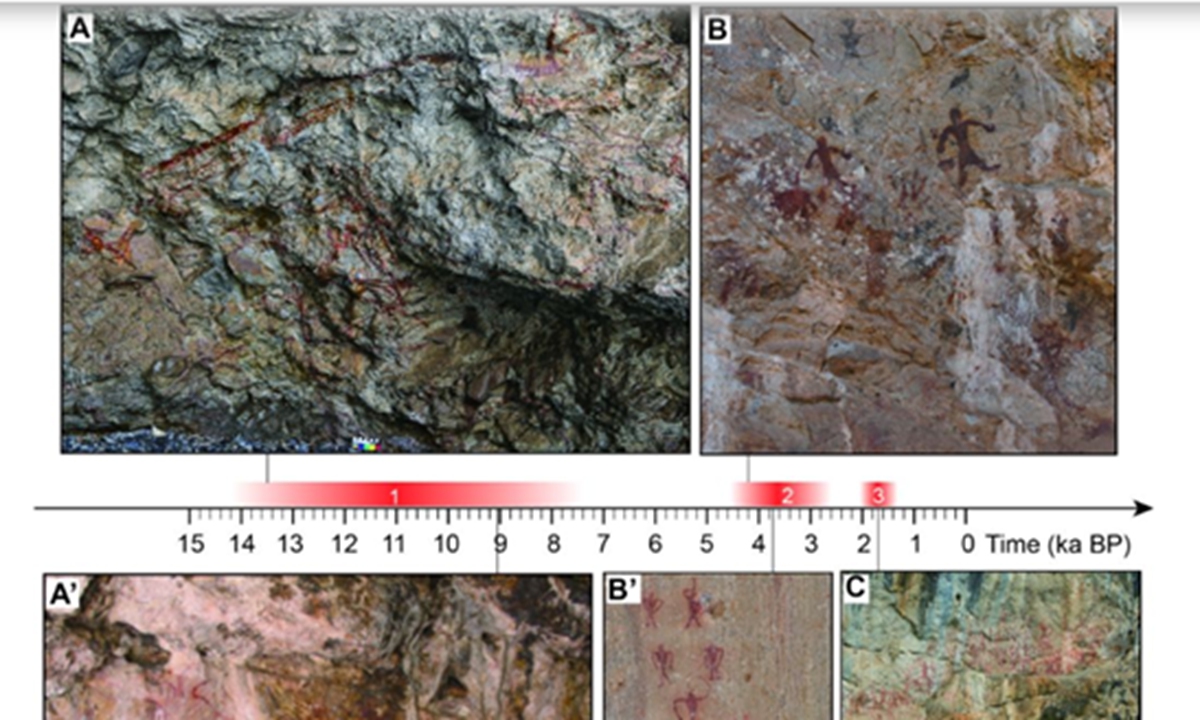
Timeline of the major painted rock art groups in Southwest China: A-A′: Jinsha River rock art; B-B′: Mangguan-Cangyuan rock art; C-C′: Zuojiang rock art Photos: Xinhua
Chinese researchers have obtained the first absolute dates for rock paintings at the Mangguan rock art site in Southwest China's Yunnan Province, pushing the known history of rock art created by prehistoric settled communities in the region back to about 4,220 years ago. The paintings also suggest cultural interactions more than 4,000 years ago between Southwest China and civilizations along the Yellow and Yangtze rivers, as well as possible exchanges with neighboring parts of Southeast Asia, including present-day Myanmar, Thailand and Vietnam, a member of the research team told the Global Times.
The Yunnan Provincial Institute of Cultural Relics and Archaeology, in collaboration with Nanjing Normal University and other institutions, have recently made a significant archaeological breakthrough. Through systematic surveys and uranium-thorium (U-Th) dating at the Mangguan site in Gengma county, the research team obtained the first absolute dates for the site's rock paintings, tracing rock art created by prehistoric settled communities back to around 4,220 years ago.
The findings were recently published in the international journal
Journal of Archaeological Science: Reports.
The Mangguan rock paintings represent one of the best-preserved prehistoric rock art sites in Yunnan. The research team presented high precision U Th dating of carbonate accretions that stratigraphically overlie the painted motifs at the Mangguan site, according to the paper published in the journal.
The dating results show that carbonate deposits overlying a human figure yielded a corrected age of 4,240 ± 19 years before present, confirming that ancient people living in the region had already produced mature figurative art at least 4,220 years ago, Wu Yun, first author of the paper and an associate researcher at the Yunnan Provincial Institute of Cultural Relics and Archaeology, was cited by the Xinhua News Agency report as saying.
Dating results from 11 samples taken from different motifs clustered between about 3,907 and 3,056 years ago. By comparison, the Cangyuan cliff paintings had previously been dated to roughly 3,800 to 2,700 years ago. The Mangguan paintings are therefore significantly older, filling an important chronological gap in the region's artistic record before the Cangyuan phase.
Shao Qingfeng, corresponding author of the paper and a professor at the School of Geography at Nanjing Normal University, told the Global Times that previous estimates dated the Mangguan rock paintings to a little over 3,000 years ago based mainly on imagery and comparisons with similar regional sites. Using microsamples of secondary carbonate deposits overlying the paintings, researchers have now obtained a precise minimum age of about 4,220 years before present without damaging the rock art.
The findings and the establishment of this chronological framework not only strengthen the archaeological foundation for studying rock art in Southwest China, but also provide a direct reference for rock art sites across Southeast Asia that have yet to undergo systematic dating, Shao said.
The findings may also challenge long-held perceptions of Southwest China around 4,200 years ago - roughly the era of the Xia Dynasty (c.2070 BC-C.1600 BC) - and help fill a key gap in understanding the pluralistic yet integrated development of Chinese civilization.
Shao said that while academic research has traditionally focused on the Yellow River and Yangtze River basins as cradles of early Chinese civilization, sites such as Mangguan and Cangyuan show that stable and culturally active communities also thrived in mountainous Southwest China. The newly established rock-art chronology brings an artistic dimension to the broader narrative of China's enduring cultural development.
Moreover, stylistic similarities suggest that Southwest China maintained exchanges with the Yellow River and Yangtze River regions and with early societies in Southeast Asia, providing material evidence of cross-regional interaction more than 4,000 years ago.
。
Current article:http://snmwe.shuosongzoutunchutao.cfd/1fg/jdezv.htm
Published on:07:53:34